Showing posts with label animata experiments. Show all posts

Monday, October 30, 2006

leaf pixelation 01

1665 pixels/blutac spots/leaves, about three days at 6hrs a day - started off at 15 fps but aout halfway thru process dropped it down to 5 as I was afraid i was going to pack it in and not finish... quite labour intensive without the apparent change of the other anims I've done this year.

I processed a clip of Lisa Griffiths (from Loom) thru AfterEffects with this 'roman mosaic' effect (and levels) to achieve the pixelation - nick suggested just lowering the res instead so will try that next time - I then exported the frames as a Jpeg sequence and imported them into Pshop for the benefit of overlaying a grid of red lines (guides) - divided the screen up into portions 5x5 pix. this worked reasonably well - i started animating using a difference mask in order to define which pixels needed to be inverted, but this quickly fucked up as leaves began to fall - and it was alot quicker to do the 'does my 5x5 square look like your 5x5 square?' comparison rather than have to take off the difference mask all the time to see what it actually should be looking like - given my penchant for confusion, this was the best way to approach it all - pretty tiring tho -

regarding the result, I feel that straight figurative is not the way to go at all - it should be a leaf static which accentuates the forms of the individual pix/leaves - they sould be different species and different sizes- but bound together by some factor (colour?) - the beauty of the leaves should be paramount, altho it could work to have a glimpse of something figurative emerge from the static at some point... i think - or maybe it should only be shapes, vertical bars moving horizontally.. something like that... the base of the animation, which is fluttering without being figurative, is my favorite part - strongest by far -

i should remember tho that this in-studio experiment would look quite different from being out insitu, with sun, wind, crawlies etc.. would figurative work better in this stuation? or just be contrived and confusing to boot?

this technique of blutac on wall was not too bad, but the removal and re-application was probably a big time killer - plus the leaves, after the first day, started falling off a fair bit, and yr having to check which way around to put them back on - pins are definitely the go..

might investigate a big pinboard to attach to....


Monday, October 23, 2006

bitmap / pixelation roundup

now admittedly more than half of this stuff is not strictly pixelation but I'm trying to collate influences and contributing factors to our perception of what constitutes an image within a grid or array of small parts over this past forever:


starting off with the mosaic, altho not a form strictly gridded by any means -


as well as the worlds apon worlds of cross-stitch


including a image to cross-stitch template generator

and onto beadwork


then on thru pointilism, again not strictly pixelation as the technique relies on the eye clouding together primary coloured dots into secondary colours, from my basic research, rather than each point representing an independant colour value - tho each dot would obviously dictate the overall form of the image -


the above is an example of not-really-pointilism

and also a pointilism patch for processing

then onto pinboard technique - an animation technique reserved for the slightly insane but none the less beautiful - brought to prominence by animators Alexander Alexeïeff & Claire Parker (Russian and American respectively), which is the very amazing technique of pushing pins in (negative space) or pulling them out (positive space) to a certain point on a pinboard matrix. and doing that alot for a very long time. looking forward to seeing the examples of their work in the ACMI lending collection next week (have to book ahead to view 16mm) - good related article on pinscreen here and lo-res google video of one of their works here


and from there I'm jumping to the concept of the bitmap image, and, well, off you go down that merry path of raster-based imagery and software and technology, from the first computer images (or did ascii pictures come first?) thru to mobile phones and basically all electronically-generated or displayed imagery in-between, film notwithstanding (until it's digitized). My understanding on all this is still slightly mushy but the point is getting to the very interesting offshoots on the concept of the pixel to pop up in the last decade, and how that relates to our perception of the image, and the moving image especially, both in a figurative and abstract form.

such as:


Jim Campbell's LED video works - one of my first experiences with this type of thing

Aram Bartholl's work - so simple, so so good - pieces for now - using tealight candles as light sources and convection for abstact pixelation, and simple techniques to quantify TV down to a "pleasing information density" as he calls it:


TV Filter


Random Screen


Paper Pixels


Bitwall 4 - Christian Moeller
- a series of stills converted into bitmap images via plastic chips produced by taking scans of the origional image (inmate portraits) and producing chips which were then re-constructed on a large vertical grid - depends on light and point of view (ie sufficiently far away from the image) for the pictures to render - which reminds me of Fabrizio Corneli's work and his use of shadow to create installed imagery like Augenblicke, even tho not pixelation.


Crayon Head - Ian Wright
Ian also does a great deal of pin (i guess you could say pinboard) pixelation art, great stuff -


Aether Architecture

- lots of abstracted pixel investigations - particularly Ping Genus Loci and Induction House


Open Burble
by Haque Design
- installation using baloons with LED lights within - not actually aiming for pixelation as such, but more as an interactive installation which is a paticipatory event. seems to be just waiting for the LED's to be programmable by those participants...


Greyworld's The Source -
Built as the main hall installation for the London Stock Exchange, this kinetic (ish) sculture trades (ha) off datasets such as the value of the pound etc to manipulate and dictate its movement, behaviour and colour. it also helpfully spells out words and symbols. Quite an interesting project in many ways, not the least of which in the fact that an interactive abstracted installation got up in the first place in this context.


Eavesdripping
- Sascha Pohflepp
- now onto the tasty stuff - - drips as pixels and the new boundaries of 'physical displays' which rely on a host of techniques to produce either still or moving images. I like eavesdripping as a project because, altho the bitmap (dripmap) it is creating is essentially a still image (a line, a word), by the nature of its bits/drips it becomes more than a static display, and futher more it is getting into very interesting territory regarding elemental and organic substances being used within the interface...

Electroland is doing some interesting work using windows, neon a also resilient LED in-floor systems to create a bunch of interactive projects based on pphysical displays, but their website's flash based so no pics


The OG and in many ways still unsurpassed (and open source) interactive physical display.... Blinkenlights
-
an unexciting east-german office block in AlexanderPlatz, Berlin, a large number of floor lamps and extension leads and the sort of gumption that only a lack of arts funding can provide, in 2001 the Chaos Computer Club began what has been an ongoing project in a variety of forms - including some pretty impressive stuff in Paris - I've particularly liked the very stong usability of the animation creation systems and applets this crew have used, and the fact that it has consistently been opened up to contributors. And the fact that it is so darn ground-up. This was the first project of this type I ever encountered (Berlin 2002), and I still rate it up there in pure groundswell and effectiveness as a community (both located and virtual) tool and experience.


Bitfall by Spherical Robots
- a programmable waterfall - akin to Eavesdripping (well not really but it's a physical display using water) but viewed on the vertical, the falling droplets compose the image (rather than the droplets hitting a surface, in eavesdripping). Pretty snazzy, to me part of the appeal is the destruction of the image, the instantaneous deconstruction into a puddle from such an intensely acknowledged image... interesting... similar implications as eavesdripping around the still image composed of moving elemental form...


Infernoptix
- pyrotechnic physical display - impress yr friends...not sure how effective this invention is, altho there's some interesting elemental aspects, for me...


Interactive Waterfall by Charles Forman
- nice use of low-res type physical display using LED's to create a simple interactive installation for a childrens hospital. I Like this work in that it is responsive in a vaguely figurative way, rather than an abstracted interactive way, given that it's in a kids hospital - and therefore an environment with alot of implications towards the physical... elegant ly chilled yet highly responsive - i like. also behind water I should add.


Space invaders by Guillaume Reymond -
- animation of a complete game of space invaders using people as pixels in a lecture hall - video here

that's the main ones I've got so far - I should be seperating the still from the moving I realise, but they feel quite entwined for me - praps cause the still works still require perception and relocation in order to view the works properly and from all their angles, and also the majority of the moving image ones are still in the slow realm of a chugging series of stills, so they are operating across picture-making and also moving image and animation. I think there are some very interesting questions around perception of image and the relationships inherent to physical displays which function in this way, and also how our visual literacy at this point in history impacts apon these things...

if anyone has other examples of bit map or pixelish encounters to suggest, muchly appreciated...

Tuesday, October 17, 2006

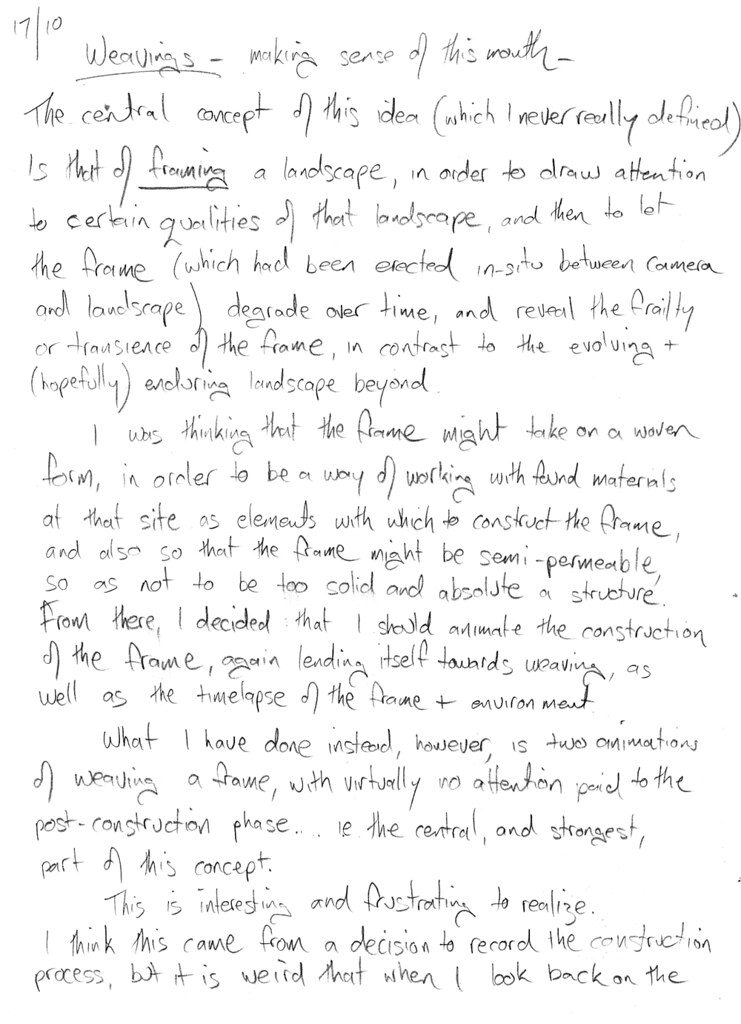
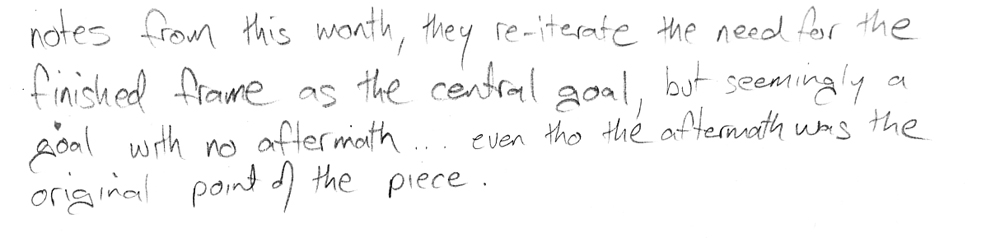
weaving wrapup thoughts

it is a frame. the weaving is incidental - a stylistic choice. it is a frame.

I think this may be due to me feeling like I had to "try out" lots of ideas, techniques, when perhaps i would have been better off getting the perameters that i wanted to explore right and then going off and doing it, rather than trying to do 'one a day', which necessarrily negated the ability to record the frame over time (post construction) - so the central concept of the work slipped away, and instead I am left with two weaving animations, rather than framing animations.

the animations i have done this month feel texturally stimulating but conceptually weak. That said, I learnt a great deal.

I am not sure i would do a view like the state library roof one again, just due to the lack of movement over time... the people on the balconies were good, and the sun moved, but the lack of green and of anything responding to wind etc made it feel a bit static. that said, had I taken images every 30 minutes for the next 24 hours, that might have been different. but i didnt think to do that, and plus i was so buggered and also cold by the time i had finished tthe actural construction phase (and its animation) that i had no wish to hang around any longer than i had to (note there was also no thermos on this weaving... big factor to have no tea).

It does seem to me that very important to all works involving static timelapse (ie where nothing is manipulated in between frames) will be (duh) to get a timelapse system for the camer setup. and also be in the sort of environment (ie remote or secure in some sense) where I can leave the camera for short periods. and also an enduring power supply.

The second weaving, on the fence at the farm, was very lovely and grassy and all but really was a bit of a tangent of concept.

The third not-quite weaving, the Mt Fraser site, would have been perhaps the closest to the idea i was getting at. Looking at the site photos I now wish I'd just done it, but its highly likely the result would not have been any closer to the concept than the other two. oh well.

Friday, October 6, 2006

Thursday, October 5, 2006

Ars Moriendi (the art of dying)


Sam Taylor-Wood: Still Life, 2001 - two stills from 35mm, 3:44 mins

Sam Taylor Wood's "Still Life" - a Old Master's stylee bowl of fruit, lit in caravaggio style - which decompses to a black glue over 3:44 minutes... small bit of video in interview here
snip from article on underground.com:

"In “Still-Life” the fruit heaped in a woven container looks luscious as a still life by Caravaggio or Zurbaran, but as our eyes roam over the peach-bloom, the light alters subtly, and a pear stalk droops downwards. Everything, suddenly, is on the move. Although the film sequence only lasts three minutes and forty-four seconds, the changes it charts are as fast as they are catastrophic. The peaches sprout a pale grey mould, the cherries are assailed by a bilious green growth, and soon everything seems about to be smothered in a frost-like blight. Once piled high and swollen with ripeness, the fruit now sinks lower and lower, until an annihilating black substance creeps across everything. In this short yet devastating film, Taylor-Wood takes the European still-life tradition, with its ominous hints of transience, and pushes it into a state of absolute decomposition. At once seductive and desolating, Taylor-Wood’s memento mori begins with vitalizing sensuality and ends in rotting negation."

and from thinking about art blog:

"Guilty pleasures! Taylor-Wood's photography leaves a lot to be desired for some people. I've liked her work, but it has never knocked my socks off. This piece was a video, just about four minutes long, of a bowl of fruit. It was timelapsed in such a way that over the course of the four minutes, the bowl of fruit moves from fresh to rotten (very rotten!). The changes are almost imperceptible but as you watch the video, mold grows and and the fruit falls apart. The clear crowd favorite, I found this piece to be hilarious. The bowl of fruit is the typical still life subject matter. Lit like an Old Master painting, Taylor-Wood first pokes fun at the notion of the still life by photographing the scene. But she doesn't stop there. She makes a video of the still life. Whereas Old Masters would only paint perfectly ripe fruit (idealizing it, perhaps?), this artist finds beauty in decay. I saw this as a possible statement that still lifes are tired as a genre and it's time for them to go away. A stretch perhaps, but I've grown tired of stale still life paintings. Still Life was a fun piece and always had dozens of people intently watching it unfold.


experimental weavers

experimental basketry - Hisako Sekijima - best article found so far here


Hisako Sekijima, Bound Space, 1997; knotted apricot; 18.5 by 14 by 3 inches.


Hisako Sekijima, From the Earth, 1990;
stitched zelkova; 10 by 12 by 15, 7.5 by 15 by 17, 5 by 16 by 16, and 5 by 7 by 7 inches.


Hisako Sekijima, Interacted Holes, 2001;
plaited walnut; 8 by 9.5 by 9.5 inches. Photo by the artist.


447hs FITTINGS V
cherry and maple,
8" x 10" x 9”
1999


Sekijima with some of her work in 1994.
All photos, unless otherwise credited, are by Tom Grotta, courtesy of browngrotta arts, Wilton, Connecticut.


AND

Jane Balsgaard
- whom I'm not sure but i think MIGHT be the artist whom I found a monogram of in Brunswick St bookstore many years ago and have been looking for ever since (not sure tho - not enough images to say - same style however):


Papersculpture, 60 x 200 x 40 cm. Paper and villow.


Studio in Ole Olsens Alle


Art of Bamboo, Java 2002


Foto: copyright Torben Dragsby

Papirkugle

1990, piassaua, håndstøbt papir, Galleri Asbæk


Lovaas & Wagle
Order
Paint, wood, nylon stockings
13 1/4 x 13 1/4", 1999
© 2000 browngrotta arts
Photo: Tom Grotta

Foto: copyright Torben Dragsby

Skylight

2000, pilekviste, kozopapir,

3 x 8 x 5 m.,
Transit, Charlottenborg


Foto: copyright Torben Dragsby

Kirkeskib

2000, pinde og håndstøbt papir,

460 x 70 x 90 cm.,
Galleri Asbæk


image from frontpage of her site


17jb TWISTED WATERANIMAL
Jane Balsgaard
willow and paper,
17.75" x 59" x 11.75”, 2002